
Caregiver in Japan for Filipinos: EPA, SSW or the Nursing Care Visa?
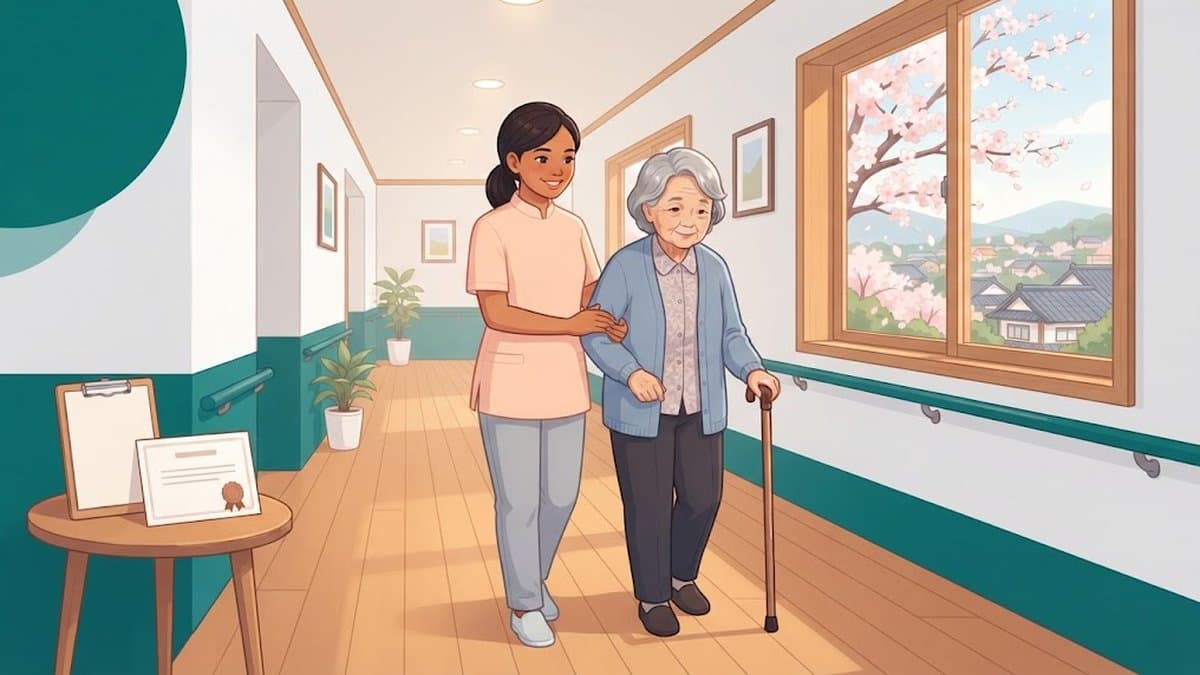
Three legal ways to work as a caregiver in Japan: EPA, SSW (i), and the Nursing Care status. Here is who each one is for, what each requires, and how they connect.
Information only, not legal advice. Verify with the DMW and the Embassy of Japan before you act.
Key Takeaways
- There are three legal ways to work as a caregiver in Japan, and they are not three doors to the same room. EPA and SSW (i) are ways in. Nursing Care is a status you can only get after you pass Japan's national care exam.
- EPA is a government-to-government program run by the DMW and JICWELS. You apply at a DMW office. The 2026 call asked for a nursing degree, or a four-year degree plus TESDA Caregiving NC II.
- SSW (i) for caregiving needs a care skills test, a basic Japanese test (JFT-Basic or JLPT N4 or higher) and the Care Japanese test. It lasts 5 years at most and you cannot bring family.
- All three can end in the same place: the Certified Care Worker (kaigo fukushishi) license and then the Nursing Care status, which allows dependents. SSW (ii) does not exist for caregiving.
- None of these routes needs you to pay a recruiter to "find you a caregiver job." Check any offer against our scam guide.
The three routes at a glance
| EPA (JPEPA) | SSW (i), caregiving | Nursing Care status | |
|---|---|---|---|
| What it is | Government program. You train toward the Japanese license while you work | A work status for people who already have basic care skills | Residence status for people who already hold the Certified Care Worker license |
| Who can apply (2026 call) | BS Nursing graduate, or a four-year graduate with TESDA Caregiving NC II | Anyone 17 or older who passes the tests | Certified Care Worker license holders |
| Tests before you go | Japanese language training is provided; a JLPT is part of the selection unless you are exempt | Care skills test + JFT-Basic or JLPT N4 + Care Japanese test | None. The license itself is the requirement |
| How long | 6 months of language training in the Philippines, 6 in Japan, then 3 to 4 years at a facility | 5 years in total at most | Periods of 5 years, 3 years, 1 year or 3 months, renewable |
| Family | Not stated in the sources I checked | Cannot join you | Spouse and children can apply for dependent status |
| Where you apply | A DMW office, by online appointment | A DMW-licensed agency and a registered employer | The employer applies for your Certificate of Eligibility or visa change |
Sources for this table: DMW Recruitment Specification Form 260002-A (31 March 2026), Embassy of Japan in the Philippines (15 April and 9 June 2026), Immigration Services Agency of Japan (ISA) pages on the SSW caregiving field, the Nursing Care status and the Dependent status.
Route 1: EPA, the government-to-government program
The Economic Partnership Agreement (EPA) between Japan and the Philippines has a caregiver track. Candidates are hired through the DMW and the Japan International Corporation of Welfare Services (JICWELS). The Embassy of Japan says more than 4,000 Filipino nurse and care worker candidates have joined since the first batch went in 2009.
Who could apply in 2026. The DMW's Recruitment Specification Form dated 31 March 2026 asked for 50 nurses and 300 careworkers. For careworkers it accepted either of these:
- A graduate of Bachelor of Science in Nursing, with or without a PRC license
- A graduate of a four-year course who submits a TESDA National Certificate II in Caregiving (NC II)
Applicants also had to be "motivated and committed to work and study" to get the Japanese national license. The form asks for an original set of documents at your DMW appointment, including your transcript, diploma, a valid NBI clearance, your PEOS certificate, a passport valid for at least six months from departure, and your TESDA NC II if you are not a nursing graduate.
The language training. The form requires 12 months of intensive Japanese before you start working: six months in the Philippines (online or face to face) and six months in Japan. If the Japan Foundation selects you, the Philippine part must be face-to-face classes in Manila. The target is N4 level by the end of the Philippine training. Some people are exempt from the JLPT in the Philippines: those with a Japanese training certificate at N3 or N4 obtained after April 2024. A JLPT N2 holder, or someone with 12 months at a Japanese language school designated by Japan's Ministry of Justice, is exempt in both countries. The form also says only applicants with a fast, reliable internet connection will be selected.
What it costs you. The Embassy of Japan says the language training is free and comes with a daily living allowance. The 2026 form lists no application fee. If anyone asks you to pay to get "slots" in EPA, stop and read what you should never pay.
The work. After the six months in Japan, you work and train for three to four years in a hospital or care facility that gives training toward the national license. Facilities are chosen for that purpose.
The exam. JICWELS says an EPA care worker candidate takes the national exam in the fourth year of stay. If you fail and cannot stay on, you go home before your stay period ends. The employer pays the return cost, per JICWELS guidance for candidates (the document I used is dated 26 February 2016, so ask JICWELS for the current version). If you pass, you can register as a Certified Care Worker and apply for the Nursing Care status.
When does the next call open? The DMW posts announcements on its Pre-Employment and Government Placement Bureau (PEGPB) page. The 2026 call closed on 24 April 2026 after an extension. Do not rely on a post from a Facebook page; open the DMW page itself.
Route 2: SSW (i) in the caregiving field
This is the route in our SSW requirements guide. For caregiving, the ISA lists the following.
The work. Physical care such as help with bathing, meals and toileting, plus related support such as recreation and helping with functional training.
The tests.
- The care skills evaluation test.
- A basic Japanese test: JFT-Basic or JLPT N4 or higher.
- The Care Japanese evaluation test, on top of JFT-Basic or JLPT.
Someone who finished Technical Intern Training (TITP) No. 2 in good standing in the care field is exempt from the skills test. A TITP No. 2 graduate in a different field still needs the Care Japanese test. The Ministry of Health, Labour and Welfare (MHLW) says you must be 17 or older to take the tests, and they are computer-based.
The employer limit. A care facility may hire SSW (i) workers only up to the number of its full-time Japanese care staff, and it must join an MHLW council for the field. The ISA says Japan expects up to 135,000 SSW caregivers over five years.
The ceiling. SSW (i) lasts 5 years in total and you cannot bring family. The ISA says caregiving is not an SSW (ii) field, because the Nursing Care status already exists for the next step.
Home-visit care. Since 21 April 2025, SSW caregivers can work in home-visit care such as visits to people's homes. The MHLW sets conditions: you must have finished the Initial Training Course for care staff, and in principle have one year or more of care experience. The employer must also give training, accompany you on early visits, explain your role to the people you visit and their families, and make a career plan with you. This matters if you want more than facility work.
For take-home pay on SSW, see SSW salary in Japan.
Route 3: the Nursing Care status is where you end up
The ISA describes the Nursing Care status as the activity of a Certified Care Worker doing care or care instruction under a contract with a Japanese organization. Since an amendment on 1 April 2020 it is granted no matter which route you took to the license.
The ISA lists periods of stay of 5 years, 3 years, 1 year or 3 months. The page shows no 5-year total ceiling like SSW (i). The Dependent status for a spouse or child is open to people who hold Nursing Care, but not to SSW (i) workers.
The application asks for a copy of your Certified Care Worker registration certificate. So from the Philippines, this is not a route you can start with. You earn the license in Japan first.
How the routes connect
- EPA to the license. You train for about four years and take the exam in year four.
- SSW (i) to the license. The Social Welfare Promotion and National Examination Center (SSSC), which runs the exam, says SSW (i) and TITP workers sit the exam on the work experience route. That route needs three years or more of care work and completion of Practical Worker Training (jitsumusha kenshu). The SSSC notes that three years of experience alone is not enough.
- License to Nursing Care. After you pass and register, you change your status to Nursing Care. The application includes a copy of your registration certificate.
The SSSC says there is no nationality or education requirement for the exam. Since the 37th exam (fiscal year 2024), it is written only. The practical test was abolished. The 39th exam's application period for this year ended on 2 September 2026, so plan your dates a year ahead.
If you are an EPA candidate, you apply through the EPA route with the JICWELS management number. Other foreign nationals cannot use it.
Which route fits you?
Ask yourself three questions.
1. Do you have a nursing degree or a four-year degree plus TESDA Caregiving NC II? If yes, the EPA call is worth watching. It comes with free language training and a built-in path to the license, but it opens only when the DMW announces a call, and it is competitive.
2. Can you pass the SSW tests, and do you want to start earlier? If you can pass the care skills test, a basic Japanese test and the Care Japanese test, SSW (i) can start without waiting for an EPA call. You will need a DMW-licensed agency and a DMW-registered employer. Read how to check a licensed agency first.
3. Do you plan to stay longer than 5 years or bring family? Then the license matters. Under SSW (i), start counting toward three years of care work and the Practical Worker Training from your first day. Under EPA, the exam is built into the program.
Check before you pay anyone
- EPA is a government program. The application happens at a DMW office, and the 2026 form lists no fee. A page that sells "guaranteed EPA slots" is not the DMW.
- For SSW, you do not pay a placement fee. See our placement fee guide.
- Passing a test does not guarantee a job or visa.
- Before you leave the Philippines you need your OEC. See why you cannot skip it.
- For the test schedule and what you register for yourself, see /tests and how to apply for tests without a fixer.
- Compare the visa paths side by side on /routes.
Sources
- Department of Migrant Workers (DMW): Recruitment Specification Form No. 260002-A, JICWELS, nurses and careworkers for Japan (31 March 2026); PEGPB services page
- Embassy of Japan in the Philippines: "JPEPA Nurse and Certified Careworker Candidates: Applications Extended" (15 April 2026); "Send-Off Ceremony Held for 18th Batch of Candidates" (9 June 2026)
- JICWELS: procedure for EPA candidates who fail the final-year national exam (26 February 2016)
- Immigration Services Agency of Japan: Status of residence "Nursing Care"; Specified Skilled Worker, Nursing Care field (as of 21 April 2025); Status of residence "Dependent"
- Ministry of Health, Labour and Welfare: Long-term care SSW skill and Japanese tests; foreign care workers in home-visit services (effective 21 April 2025 for SSW)
- Social Welfare Promotion and National Examination Center (SSSC): Certified Care Worker national exam, eligibility routes, EPA route, and work experience route
- Hanapon: /routes, /tests, /scam
About this guide
Free, honest guide to working and studying in Japan
- ●Every rule is checked against DMW and Immigration Services Agency sources
- ●Written in plain English, with Tagalog where it matters
- ●No job ads, no referrals, no fees from agencies
- ●Corrections welcome through the contact form
Hanapon is run from Manila by a Japanese engineer who reads the Japanese-language rules directly and checks them against what agencies tell applicants here. If something on this page is out of date, tell us and we will fix it.
Before you pay anyone, check the license.
Free, one minute, and it is the single step that stops most scams.
Related Articles

Jobs in Japan for Filipinos Without Experience: Legal Routes
Jobs in Japan for Filipinos without experience: the SSW (i) test route, Ikusei Shuro from April 1, 2027, average pay, and how to check high-salary offers.
10/17/2026

How to Apply for an SSW Visa in Japan: Every Step in Order
How to apply for an SSW visa in Japan from the Philippines, step by step: tests, agency, MWO and DMW, COE, visa, PDOS, OEC. Who does each step and how long.
10/15/2026

Office Work in Japan for Filipinos: Gijinkoku Visa Guide
Office work in Japan for Filipino graduates on the Gijinkoku visa: which jobs qualify, degree match, the pay rule, the COE and MWO-Tokyo steps.
10/14/2026
Work in Japan for Filipino Teachers: JET and Visa Rules
How Filipino teachers can work in Japan: JET ALT under the Instructor status, English schools under Gijinkoku, degree rules, and the JET 2027 deadline.
10/11/2026
What Is the SSW (ii) Visa in Japan? A Guide for Filipinos on SSW (i)
SSW (ii) lets skilled workers stay in Japan with no 5-year limit and bring their family. Here is which fields have it, what the test asks, and how it links to permanent residency.
10/4/2026
Certificate of Eligibility for Japan: Requirements and Timeline
Who files the COE, what it costs, how long it takes for SSW (i) and how long it stays valid, plus the food service stop. Based on Japan's own immigration data.
9/26/2026