
What Is the SSW (ii) Visa in Japan? A Guide for Filipinos on SSW (i)
SSW (ii) lets skilled workers stay in Japan with no 5-year limit and bring their family. Here is which fields have it, what the test asks, and how it links to permanent residency.
Information only, not legal advice. Verify with the DMW and the Embassy of Japan before you act.
Key Takeaways
- SSW (ii) is the higher level of the Specified Skilled Worker status. It is for people who can do skilled work on their own or lead a team on site.
- The period of stay is 3 years, 2 years, 1 year or 6 months, and it can be renewed. Only SSW (i) has the 5-year total limit.
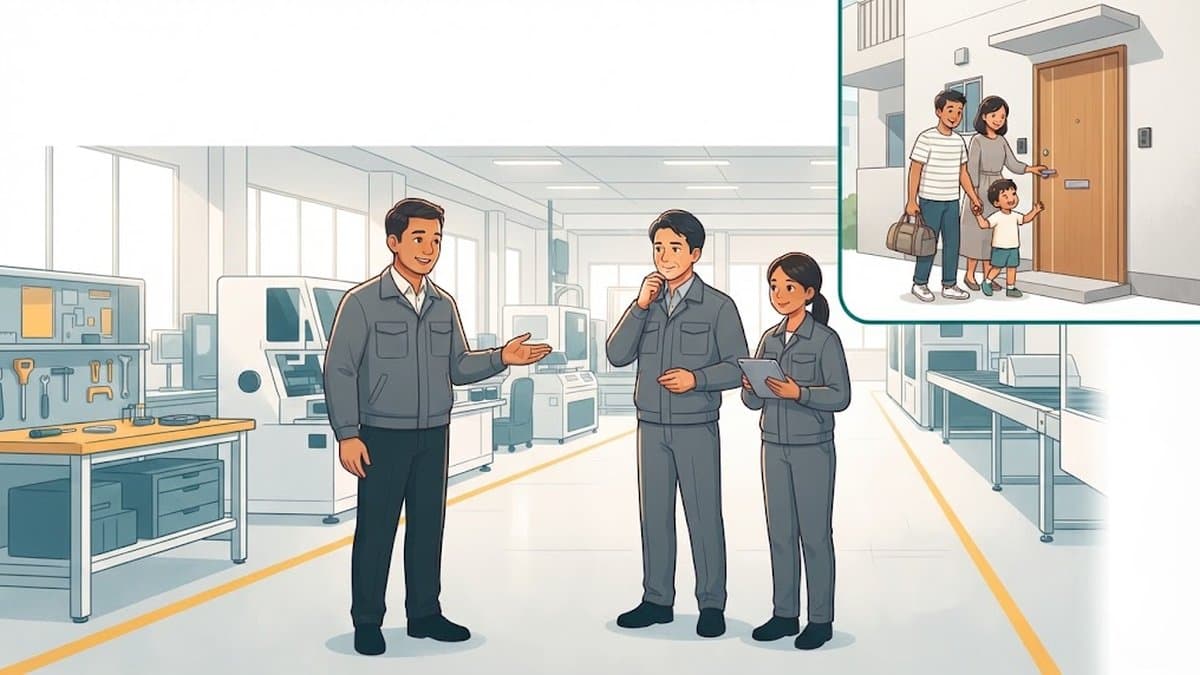
- Your spouse and children can live with you in Japan on a "Dependent" status. Under SSW (i), they basically cannot.
- 11 fields have SSW (ii). Caregiving does not. Caregivers move up through the Care Worker visa instead.
- To qualify, you pass your field's SSW (ii) skills test (set at the level of Japan's Trade Skill Test grade 1) and meet the field's practical experience rule, usually experience as a supervisor.
- Years on SSW (ii) count toward the work years needed for permanent residency. Years on SSW (i) do not.
- As of June 2026, 18,295 people held SSW (ii). Only 771 of them were Filipinos.
- This guide does not repeat the SSW (i) requirements. For those, read our SSW requirements checklist. To compare routes, see TITP vs SSW vs Ikusei Shuro.
SSW (i) vs SSW (ii) at a glance
| SSW (i) | SSW (ii) | |
|---|---|---|
| Skill level | "Considerable knowledge or experience" in the field | Skilled, advanced work; can supervise others |
| Period of stay | Set by the Minister of Justice | 3 years, 2 years, 1 year or 6 months (renewable) |
| Total stay limit | Basically 5 years | No total limit stated (renewable) |
| Family (spouse, children) | Basically not allowed | Allowed on "Dependent" status |
| Mandatory support plan from employer | Required | Not required |
| Counts toward permanent residency work years | No | Yes |
The biggest change for most people is the last three rows: you can stay long term, bring your family, and start building toward permanent residency.
One side effect: the employer no longer has to provide the support services required for SSW (i), such as orientation, Japanese study support and regular face-to-face meetings. You are treated as an experienced worker who can manage on your own.
Which fields have SSW (ii)?
Until 2023, SSW (ii) existed only in construction and shipbuilding (welding). In June 2023 only 12 people in all of Japan held it. In June 2023 the Cabinet opened SSW (ii) to almost every field, starting August 31, 2023.
| Field | SSW (ii) available? |
|---|---|
| Building cleaning | Yes |
| Industrial products manufacturing | Yes |
| Construction | Yes |
| Shipbuilding and marine | Yes |
| Automobile maintenance | Yes |
| Aviation | Yes |
| Accommodation | Yes |
| Agriculture | Yes |
| Fisheries | Yes |
| Food and beverage manufacturing | Yes |
| Food service | Yes |
| Caregiving | No (use the Care Worker visa route) |
| Automobile transport (truck, bus, taxi) | No |
| Railway | No |
| Forestry | No |
| Wood industry | No |
| Linen supply, logistics warehouse, resource circulation | Newer fields. Check with the Immigration Services Agency (ISA) |
The four fields added in March 2024 (automobile transport, railway, forestry, wood industry) are SSW (i) only. If you work in caregiving, read our caregiver guide for the long-term route.
How to qualify for SSW (ii)
Every field uses the same basic idea. You must prove two things:
- Skill. Pass the SSW (ii) skills evaluation test for your field. Japan's March 2025 test policy sets this test at the same level as Trade Skill Test grade 1, the exam for upper-level skilled workers.
- Practical experience. Meet the field's experience requirement. In most fields this means working as a supervisor or team leader who directs other workers.
The exact rules differ by field. The table shows what is confirmed for one field and where you need to check yourself.
| Field | Test | Japanese | Experience |
|---|---|---|---|
| Food service | Food Service SSW (ii) skills test (run by OTAFF) | JLPT N3 or higher | Supervisor experience, such as sub-manager, directing several staff (including part-timers or SSW workers) at a licensed restaurant. Required years: check with the ministry |
| Fisheries | Fisheries SSW (ii) test | Check with the ministry | Check with the ministry |
| Construction, manufacturing and others | Field's SSW (ii) test | Check with ISA / your field's ministry | Supervisor experience; required years: check with your field's ministry |
A note for food service: the sample score sheet shows a pass mark of 163 out of 250. ISA also lists a special measure for people who came close. If you scored at least 80% of the pass mark and have JLPT N3 (or at least 80% of the N3 pass mark), you can submit proof of that. Ask the test organizer or ISA how it applies to you before relying on it.
About the test itself
From the March 2025 test policy:
- SSW (ii) tests are basically held in Japan, for people already living there. Holding them abroad is possible depending on demand.
- Each field should hold the test at least twice per fiscal year (April 1 to March 31).
- You can take the test in Japan while holding another status of residence, so SSW (i) holders can sit it.
- Test takers are basically 17 or older.
- Passing does not guarantee a visa.
Apply for the test yourself. See /tests for how the tests are organized. If someone asks for money to "guarantee" a pass or a visa, check /scam first.
Moving from SSW (i) to SSW (ii)
You do not leave Japan to switch. You file an Application for Change of Status of Residence at immigration. The documents include:
- The application form and a photo
- Your passport and residence card
- Documents from your employer
- Field-specific documents, such as your test result notice
Some employer documents can be skipped if the company has a good track record with ISA.
Whether you must use up your 5 years on SSW (i) before switching is not stated in the sources we checked. Check with ISA.
If you are thinking of changing employers at the same time, read changing jobs in Japan first, because a new employer also means new paperwork.
Bringing your family
On SSW (ii), your spouse and children can join you in Japan on the "Dependent" (Kazoku Taizai) status. This is one of the main reasons people work toward SSW (ii). On SSW (i), family basically cannot come.
SSW (ii) and permanent residency
Japan's permanent residency guideline (revised February 24, 2026) basically asks for:
- 10 or more years of continuous residence in Japan, and
- within that, 5 or more continuous years on a work status or a residence status.
The work statuses that count exclude Technical Intern Training and SSW (i). SSW (ii) is not excluded, so your SSW (ii) years count toward the 5 years. Your SSW (i) years do not count toward those 5 years.
In practice, permanent residency becomes realistic only after you move up to SSW (ii). For the full list of conditions, see our permanent residency guide.
The numbers: how many people hold SSW (ii)?
From the ISA statistics for June 30, 2026 (preliminary):
| Number | |
|---|---|
| All SSW holders | 444,256 |
| SSW (i) | 425,961 |
| SSW (ii) | 18,295 |
| SSW (ii) at end of December 2025 | 7,955 |
SSW (ii) more than doubled in six months (+130%). It is still small: about 4 of every 100 SSW workers.
By nationality (SSW (ii), June 2026)
| Nationality | Holders | Share |
|---|---|---|
| Vietnam | 13,761 | 75.2% |
| China | 1,324 | |
| Indonesia | 1,125 | |
| Philippines | 771 | 4.2% |
| Myanmar | 448 |
Filipinos on SSW (ii) rose from 341 in December 2025 to 771 in June 2026. But there are 37,859 Filipinos on SSW (i), so only about 2 in 100 Filipino SSW workers have moved up so far.
By field (SSW (ii), June 2026)
| Field | Holders |
|---|---|
| Construction | 5,329 |
| Food and beverage manufacturing | 4,703 |
| Agriculture | 2,387 |
| Industrial products manufacturing | 2,386 |
| Food service | 2,046 |
| Automobile maintenance | 670 |
| Shipbuilding and marine | 644 |
| Accommodation | 57 |
| Fisheries | 43 |
| Building cleaning | 24 |
| Aviation | 6 |
What to do now if you are on SSW (i)
- Confirm that your field has SSW (ii) using the table above.
- Find your field's SSW (ii) test page and check the Japanese and experience rules. Where this guide says "check," ask ISA or your field's ministry.
- Talk to your employer about supervisor or team-leader duties, since most fields require that experience.
- If your field needs JLPT N3, start studying now.
- Keep your records (pay slips, job titles, test results). You will need them for the change of status application.
Sources
- Immigration Services Agency of Japan, "Specified Skilled Worker" status page: https://www.moj.go.jp/isa/applications/status/specifiedskilledworker.html
- Immigration Services Agency of Japan, SSW system overview (updated October 1, 2026): https://www.moj.go.jp/isa/applications/ssw/index.html
- Immigration Services Agency of Japan, expansion of SSW (ii) fields (Cabinet decision June 9, 2023): https://www.moj.go.jp/isa/applications/ssw/03_00067.html
- Immigration Services Agency of Japan, Cabinet decision of March 29, 2024: https://www.moj.go.jp/isa/applications/ssw/2024.03.29.kakugikettei.html
- Ministry of Justice and MHLW, test policy for SSW and Ikusei Shuro (March 11, 2025): https://www.moj.go.jp/isa/content/001434823.pdf
- Immigration Services Agency of Japan, food service field page: https://www.moj.go.jp/isa/policies/ssw/foodservice.html
- Immigration Services Agency of Japan, food service SSW (ii) score sheet notes: https://www.moj.go.jp/isa/content/001447003.pdf
- Immigration Services Agency of Japan, SSW statistics as of June 30, 2026 (preliminary): https://www.moj.go.jp/isa/content/001459490.pdf
- Immigration Services Agency of Japan, SSW statistics as of June 30, 2023: https://www.moj.go.jp/isa/content/001403330.pdf
- Immigration Services Agency of Japan, Permanent Residency guidelines (revised February 24, 2026): https://www.moj.go.jp/isa/applications/resources/nyukan_nyukan50.html
About this guide
Free, honest guide to working and studying in Japan
- ●Every rule is checked against DMW and Immigration Services Agency sources
- ●Written in plain English, with Tagalog where it matters
- ●No job ads, no referrals, no fees from agencies
- ●Corrections welcome through the contact form
Hanapon is run from Manila by a Japanese engineer who reads the Japanese-language rules directly and checks them against what agencies tell applicants here. If something on this page is out of date, tell us and we will fix it.
Before you pay anyone, check the license.
Free, one minute, and it is the single step that stops most scams.
Related Articles

Jobs in Japan for Filipinos Without Experience: Legal Routes
Jobs in Japan for Filipinos without experience: the SSW (i) test route, Ikusei Shuro from April 1, 2027, average pay, and how to check high-salary offers.
10/17/2026

How to Apply for an SSW Visa in Japan: Every Step in Order
How to apply for an SSW visa in Japan from the Philippines, step by step: tests, agency, MWO and DMW, COE, visa, PDOS, OEC. Who does each step and how long.
10/15/2026

Office Work in Japan for Filipinos: Gijinkoku Visa Guide
Office work in Japan for Filipino graduates on the Gijinkoku visa: which jobs qualify, degree match, the pay rule, the COE and MWO-Tokyo steps.
10/14/2026
Work in Japan for Filipino Teachers: JET and Visa Rules
How Filipino teachers can work in Japan: JET ALT under the Instructor status, English schools under Gijinkoku, degree rules, and the JET 2027 deadline.
10/11/2026
Caregiver in Japan for Filipinos: EPA, SSW or the Nursing Care Visa?
Three legal ways to work as a caregiver in Japan: EPA, SSW (i), and the Nursing Care status. Here is who each one is for, what each requires, and how they connect.
10/3/2026

Certificate of Eligibility for Japan: Requirements and Timeline
Who files the COE, what it costs, how long it takes for SSW (i) and how long it stays valid, plus the food service stop. Based on Japan's own immigration data.
9/26/2026